AI Is Usually Not the Product
A sharper test for deciding whether AI is the product, the interaction layer on top of a scarce asset, or simply table-stakes UX.
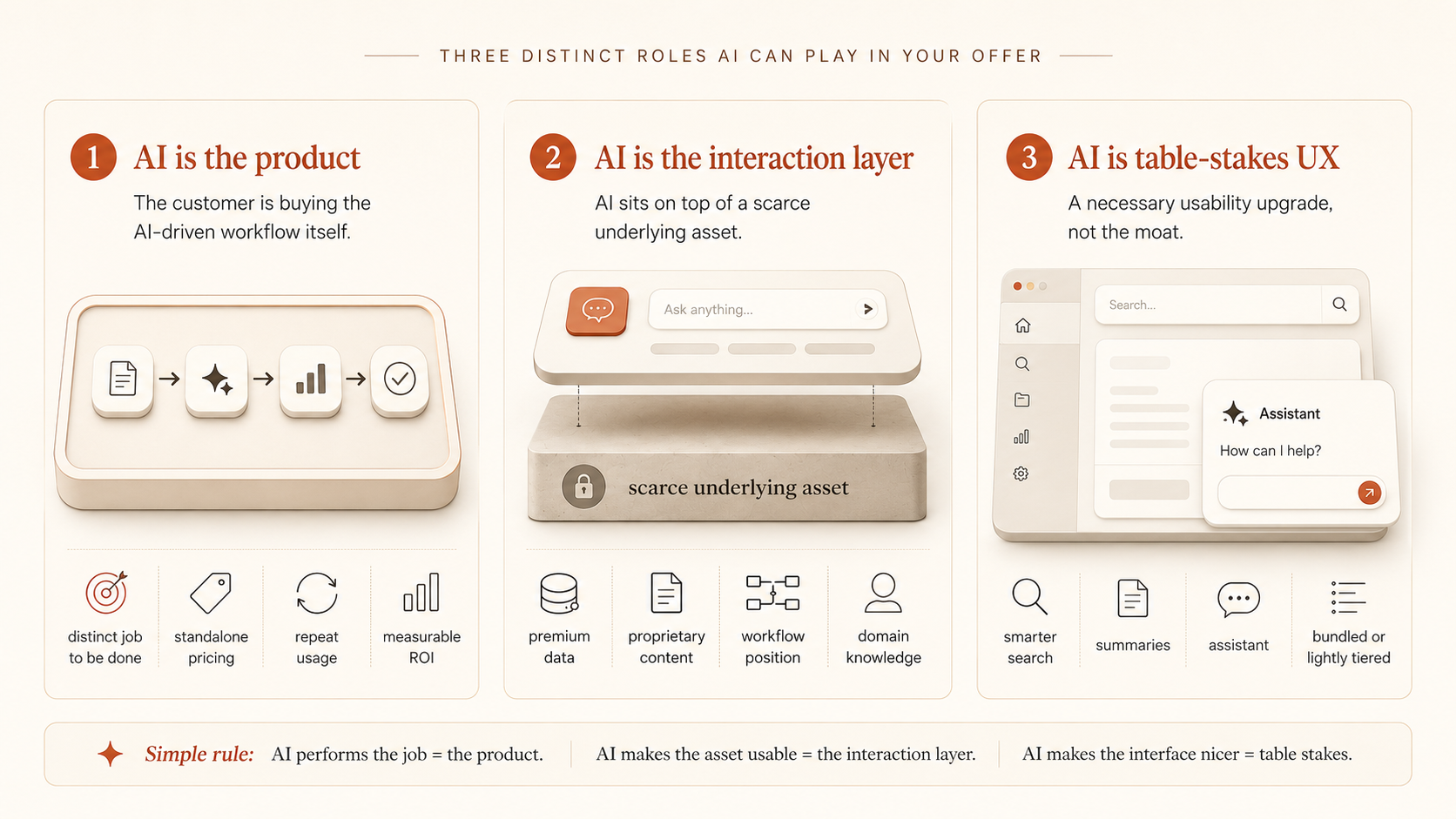
Every executive team is now asking some version of the same question: what is our AI product strategy? It is a reasonable question, but in most cases it is still too fuzzy to be useful. It invites a discussion about tools, features, demos, pricing, and competitor moves before the more basic commercial question has been answered.
The better question is simpler and harder: what role is AI actually playing in your offer?
There are only three honest answers.
- AI can be the product.
- AI can be the interaction layer on top of a scarce asset.
- Or AI can be table-stakes UX.
If you do not know which one you have, you will almost certainly misprice it, mis-sell it, and misjudge its strategic importance.
That confusion is everywhere right now. Companies are bolting AI onto data platforms, insights products, research tools, and services businesses, then immediately debating whether to charge separately, bundle it, or use it for stickiness. They worry about cannibalization, unclear buyer personas, and whether clients will pay for something they increasingly expect anyway.
All of that noise usually points to one core problem: the company has not decided what AI is in the business model.
Most AI is not the moat
A lot of leaders still behave as if AI on top of proprietary data is, by itself, a meaningful strategic position. Usually, it is not. The foundation-model layer is improving too quickly and commoditizing too fast. Prompting, summarization, and basic copilots are not durable advantages. A chat interface on top of a dataset is rarely a business model breakthrough.
It is often just the modern minimum.
That does not mean AI is unimportant. It means AI’s strategic value usually sits above the model layer and around the scarce asset, not inside the model itself. That distinction matters enormously, because it changes how you price, how you sell, how you invest, and how you explain the product to customers.
The three roles AI can play
1. AI is the product
This is the cleanest case. The customer is explicitly buying the AI-driven workflow itself: a simulator, a forecasting engine, a protocol design assistant, a stakeholder modeling tool, or a decision engine. The AI performs a distinct job that the customer plausibly would pay for even without your legacy product.
There are very few successful pure AI-is-the-product examples, but a cleaner example than most is Abridge. Abridge sells AI-powered clinical documentation. Its product listens to patient-clinician conversations, generates structured clinical notes in real time, maps content into the medical record workflow, and keeps clinicians in the review loop before finalization. In other words, the AI is not merely helping users search or interrogate an existing information asset. It is doing the core job the customer is paying for: reducing documentation burden and producing usable clinical documentation at the point of care.
Kantar’s LINK AI also comes close. Kantar is selling a self-serve predictive ad-testing workflow. Users can upload creative, have the system analyze it, predict in-market performance, benchmark it, and get results in as little as 15 minutes. LINK AI is available self-serve, pay-as-you-go, or in subscription bundles.
The distinction is in the job the customer is hiring it to do. The user is not mainly interrogating Kantar’s corpus manually or via an LLM. The system is using Kantar’s proprietary data asset to do a bounded commercial job for the user: test creative and inform a go/no-go, refine, or iterate decision. That pushes LINK AI much closer to AI is the product than to AI is just an enhancement.
AI-is-the-product offers the highest upside potential. It can support standalone pricing, usage-based monetization, and software-like economics. It is also the hardest to prove. To win here, you need a clear job to be done, repeat usage, measurable ROI, and enough workflow integration and embedding that the offer is not just a thin wrapper around frontier models.
Most companies want to believe they are here. Few actually are.
2. AI is the interaction layer
In this model, the customer is still fundamentally buying the underlying assets: premium data, proprietary content, exclusive transcripts, workflow position, domain knowledge, or similar forms of scarcity. AI radically improves access to the asset. It makes the asset easier to interrogate, more usable by non-experts, more frequently used, and more embedded in real workflows.
A good example is a platform like AlphaSense. The core asset is not the AI. It is the premium corpus: research, earnings transcripts, expert calls, company documents, and the enterprise’s own internal knowledge. The AI layer makes that corpus dramatically more usable. It surfaces, compares, summarizes, monitors, and increasingly acts on behalf of the user.
This may feel like a trivial enhancement, and perhaps one day it will be. But at the moment, it is a real economic lever. The important point is that the monetization logic is different from an AI-is-the-product business.
In this model, AI usually should not be thought of primarily as a standalone SKU. Its value is often captured indirectly through better retention, broader adoption, more seat expansion, deeper workflow embedment, stronger pull-through of premium content, and higher enterprise penetration.
This is where many executives get lost. They look at a powerful AI enhancement and ask, “What should we charge for the AI?” The better question is, “How much more value does the AI help us realize from the scarce underlying asset?”
That is a more strategic question, and usually the right one.
3. AI is table-stakes UX
Sometimes AI is mostly a usability upgrade: a smarter search bar, a basic assistant, lightweight summarization, or a more modern interface. It improves convenience and helps the product avoid feeling dated, but it does not materially change value capture, workflow ownership, or defensibility.
Zoom is a good example. Most customers are not buying Zoom primarily for AI. They are buying meetings, communications, and collaboration. The AI features, including summaries, notes, action items, and meeting assistance, make the core product more useful and stickier, but they do not fundamentally redefine what Zoom is.
That is why this kind of AI should usually be bundled or lightly tiered, not treated as a major standalone product in its own right. Trying to separately monetize it often creates more friction than value.
The danger here is internal self-deception. Teams overestimate the importance of what is, in reality, a necessary interface upgrade.
The commercial mistakes this confusion creates
Once you see the three roles clearly, a lot of common AI commercialization pain becomes easier to diagnose. If you think AI is the product when it is really just the interaction layer, you will overprice it and struggle to sell it. If you think AI is just a feature when it is actually becoming a distinct workflow product, you will under-invest and leave money on the table. If you treat table-stakes UX as a strategic breakthrough, you will waste management time and confuse customers.
This is especially visible in data and insights businesses, where the product is often a complicated mix of proprietary data, workflow access, expert interpretation, and customer trust.
A company builds an AI engine on top of a proprietary dataset and immediately runs into the same questions. Should we bundle it? Should we sell it separately? Should we use it to drive stickiness? Will it cannibalize existing reports? Does the buyer stay the same, or does the user base broaden? Are clients even allowed to use AI tools?
These are reasonable questions, but they are downstream questions. They are signs that the company has not yet decided whether the AI is the offer, the access layer to the offer, or just modern packaging.
What actually compounds?
One more distinction is worth making. The model layer itself is not where most compounding value lives.
The durable value usually comes from proprietary data and context, embedded workflows, domain ontologies, governance and trust, distribution, and feedback loops from real usage.
That is why the most thoughtful companies are not trying to outbuild the frontier labs. They are building systems around the models: orchestration, workflow logic, role-based access, validation, human review, auditability, and domain-specific context.
This is less glamorous than announcing a new AI product. It is also where the real work usually sits.
A simple rule for executives
Here is the cleanest test.
If AI performs the job itself, it is the product.
If AI makes the asset usable, it is the interaction layer.
If AI just makes the interface nicer, it is table stakes.
That sounds simple because it is. More importantly, the simplicity forces a level of clarity that many executive teams still lack.
The companies that win will be the ones that understand exactly where AI sits in their value stack, how it changes their economics, and where the real scarcity still lives.